

Using the Strategic Formula System for Competitive Analysis
Five gyms, five formulas, and only two hold a real competitive advantage that price doesn't predict.


Executive Summary
Applying the Strategic Formula System to five gyms operating under a single consumer category — Planet Fitness, Equinox, CrossFit, Orangetheory, and Peloton — resolves them into only two structurally distinct positions of durable advantage, classified by business model, strategy, and competitive advantage rather than by price. Four of the five share the same underlying business model, selling temporary access to an owned asset; what separates them is not tier or cost but whether a given formula contains a genuine switching cost — a structural condition where leaving imposes real loss, effort, or disruption on the customer — or whether it instead depends entirely on ongoing execution with no such lock in place. Price positioning shows no relationship to which formulas hold that condition and which do not: the lowest-priced and highest-priced entrants in the set both lack it, while a mid-tier competitor holds the strongest version of it in the group. The mechanism at issue is switching cost formation, not brand strength, service quality, or market share, and it is this mechanism — present or absent — that determines whether a company’s position can be defended against a new entrant.
Copying a competitor’s price and strategy does not copy the advantage that made the original position defensible.
Strategic Mechanism
Applied to five named competitors, the same three-part classification method separates advantage from price entirely.
Four of the five formulas share the same business model, Landlord, selling temporary access to an owned asset.
Strategy varies across all five formulas, but a different strategy alone never creates or removes advantage.
Equinox and CrossFit each carry a structural condition, sustained by attendance, that imposes real cost on leaving.
Orangetheory shares CrossFit’s price tier and workout format but lacks the same competitive advantage, resolving instead to Operational Parity.
Peloton’s brand loyalty never reached the advantage threshold; preference without exit cost resolves to Operational Parity, not Demand.
Prefer to listen? Here’s the audio edition of this post:
The fitness industry is almost always analyzed as a price ladder. Cheap gyms at the bottom, premium clubs at the top, everyone else sorted in between, and the company with the most members is declared the winner. The ladder is easy to draw and it explains almost nothing about who can defend their position.
My book describes competitive analysis as one use case for my system, so I thought I would demonstrate the process using five of the biggest players in fitness. The Strategic Formula System classifies any business as (Business Model + Strategy) × Competitive Advantage. If I write out the formulas for Planet Fitness, Equinox, CrossFit, Orangetheory, and Peloton and set them side by side, the similarities and differences the price ladder hides become the whole story. Five companies, five formulas, but only two of them contain a real advantage, and they are not the two the price tag would predict.
How the Strategic Formula System Describes a Business
The business model is how a company creates and captures value. A gym that owns its building and equipment and sells temporary access is a Landlord, the same structural role as a parking garage or an office leaseholder. The strategy is how the company competes inside that model: on price (Low Cost), on prestige (Premium Branding), on a built-in community (Network Expansion), or on the quality of the offering (Performance & Quality).
Competitive advantage is the strictest layer, and most businesses do not have one (what the system calls Operational Parity). Advantage is a structural condition that lets a company hold its customers without re-earning them every month.
Five Fitness Companies, Five Strategic Formulas
Planet Fitness: L + Lo + Op
Planet Fitness owns its equipment and sells access to it, so the business model is Landlord. The strategy is Low Cost: ten dollars a month against a membership base far larger than any location could hold at once. The model is solvent because most of those members rarely come. That is exactly why the formula ends in Operational Parity instead of a competitive advantage. The only customer-side lock a commodity gym can build is habit, and habit requires attendance. By filling its rolls with members who do not attend, the model forecloses the one advantage available to it. The cost advantage usually credited to Planet Fitness is real, but it lives at the parent company, spread across thousands of locations through national purchasing and advertising. It does not exist inside the club you would walk into.

Equinox: (L + Pm) × D
Equinox is also a Landlord selling access to a facility, but the strategy is Premium Branding and the formula carries a real Demand advantage. The lock is built from habit and identity together. A member who trains at Equinox several times a week has a routine, a trainer who knows them, and a membership that has become part of how they see themselves. Leaving costs all of that, which is a true switching cost. The qualifier is that the advantage holds only for the member who actually shows up. For the member who joined for the logo and never goes to the gym, there is no routine and no real identity attached. The advantage is earned through attendance, not bought at signup.
CrossFit: (L + Ne) × D
A CrossFit box is a Landlord that competes on a built-in community, a strategy my system calls Network Expansion. The format does the work: classes are done together, scored together, and built around the same people showing up at the same hour, so the value of the membership rises with the other members in the room. That is a genuine interdependence, not simply a slogan. The routine, the identity of being a CrossFitter, and the social ties to the people on the other mats create the Demand advantage. Leaving means walking away from a group, which is a far harder exit than canceling a card. This is the position no one expects to be the most defended, and it sits well below the premium tier on price.
Orangetheory: L + Q + Op
Orangetheory looks adjacent to CrossFit and lands somewhere else entirely. It is a Landlord competing on Performance & Quality: the structured heart-rate workout and the measured results that strategy delivers. What it does not have is interdependence. The class is coached and quantified, but my workout does not depend on yours, and the method is not proprietary enough to stop a competitor from running a near-identical session down the street. For the regular who has built a habit there is a thin hold, but the position as a whole resolves to parity. Separating Orangetheory from CrossFit is the single most useful cut the instrument makes here, because the prices are similar and the formats look alike, while the advantage layer is the difference between a lock and none.
Peloton: Md + Pm + Op
Peloton is the one company here that is not a Landlord. It manufactures a product and sells it directly, a Manufacturer Direct business model, with a content subscription layered on top and Premium Branding as the strategy. Peloton built its numbers on the bet that the brand and the instructors had created a Demand advantage, essentially that people were Peloton people and would not leave. The bet failed the test. Owning the bike is a sunk cost, not a switching cost, and nothing about having bought the hardware makes a competitor’s class harder to buy. The workout history is not heavy enough to count as accumulated state worth staying for. What Peloton actually held was brand preference, which is not a competitive advantage, so the strategic formula resolves to Operational Parity.
What the Formulas Share, and Where They Split
Stack the five strategic formulas against each other and the price ladder dissolves.
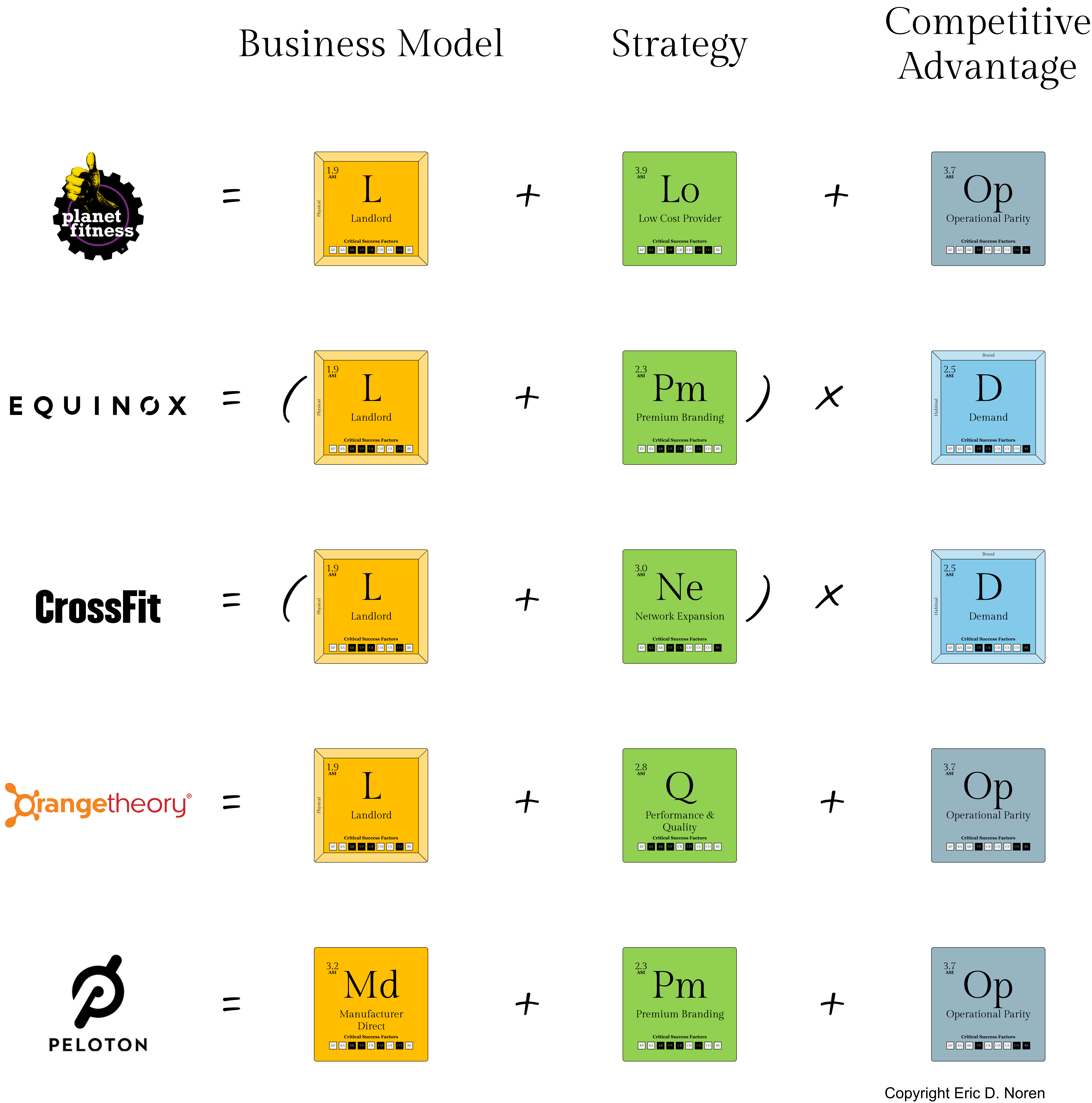
Four of the five share a business model. Planet Fitness, Equinox, CrossFit, and Orangetheory are all Landlords selling access to an owned space. Peloton is the only structural outsider, a manufacturer that sells a product and tried to run an access business on top of it. So the layer everyone treats as the big difference, cheap gym versus premium club versus home equipment, is mostly the same layer wearing different prices.
The strategies split four ways, and that is where the companies genuinely diverge: Low Cost, Premium Branding, Network Expansion, Performance & Quality. These are real differences in how each company competes. But strategy is reversible and copyable. None of it, on its own, is a moat.
The advantage layer is where the comparison pays off, and it ignores price completely. Two formulas carry a multiplication sign, Equinox and CrossFit. Three are additive, Planet Fitness, Orangetheory, and Peloton. The cheapest serious option and one of the most expensive both sit at parity. A mid-priced community box holds the strongest advantage in the field; the most expensive product holds none. If price predicted competitive advantage, the formulas would sort cleanly from cheap to premium, but they do not sort at all.
Who Actually Competes with Whom
The pricing ladder implies one contest with everyone on it, but the strategic formulas show a more nuanced fitness marketplace.
Planet Fitness does not compete with Equinox. They share neither a customer nor a strategy, and a member choosing between the two is rare. Planet Fitness competes with the other low-cost access chains that share its formula. The deciding factor is not anything at the club, but the parent-level scale advantage a single location cannot reproduce.
Equinox competes with the other premium clubs on the depth of the habit-and-identity lock. CrossFit competes with other boxes, and partly with Orangetheory, for the customer who wants a coached group workout. Peloton competes with the rest of the at-home options. Five companies, at least four separate contests, none of which the price ladder draws.
What the Analysis Means for a New Gym
Put this in front of someone deciding where to open a gym, and the strategic formula system earns its keep.
The membership leaderboard points them at Planet Fitness and says copy the winner, but the strategic formula says the opposite. Copying Planet Fitness means building a Low Cost Landlord business at a single location, but the cost advantage that protects the chain does not exist for a single location, and the habit lock is foreclosed by the low-price model itself. That is a recipe for a business with no competitive advantage, a thin margin, and nothing to defend.
The advantage that holds Equinox and CrossFit is built from attendance and community, and an operator who designs for both can begin building it on day one. The gap on the map is wherever a position with a real lock is underserved locally. The target is wherever a competitor is sitting in parity and calling its membership count a moat.
My system does not tell the operator which to choose, and the decision rests on local marketplace factors. But it can draw the map: which positions hold an advantage, which only look strong, and which contest each one would actually be entering. That choice depends on capital, risk, and what kind of business the operator wants to run. What the instrument removes is the most expensive mistake on the board, copying a leader whose advantage cannot be copied and mistaking a long membership roster for a position that can be held.
Membership count and the price ladder will keep being held up as success metrics for the industry because they are simple and the numbers are public. Write the strategic formulas instead and the question changes from who is biggest to who is holding something that can be protected against a new entrant. Only two of the five meet that bar.
About the author: Eric D. Noren is the creator of the Periodic Table of Business Strategy and author of The Strategic Formula: A New System for Business Strategy in the AI Age (August 2026 — order on Amazon). Learn more at ericdnoren.com.
AI Disclosure: This essay is fully conceived, argued, and structured by me. I use AI tools as a research and drafting partner, but the strategic ideas and final decisions are my own.