

From Aggregation to Acceleration: How AI Will Reshape Business Strategy
An Introduction to Learning-Loop Economics

Executive Summary
Artificial intelligence shifts the primary source of advantage from demand aggregation to learning acceleration. In the AI era, firms that own tightly integrated learning loops compound advantage through learning velocity rather than scale alone. Learning-Loop Economics describes a mechanism in which proprietary interactions, automated feedback, and rapid model integration convert usage directly into improvement. Competitive position is determined by control of the feedback loop, not control of distribution.
Firms win not by owning customers, but by owning the system that learns from every interaction.
Strategic Mechanism
Learning-Loop Economics describes how integrated feedback systems convert interaction flow into accelerating model improvement.
Proprietary user interactions are captured, structured, and routed into tightly coupled training and inference pipelines.
Automated learning loops update internal representations probabilistically as new signals accumulate across heterogeneous touchpoints.
Real-time personalization feedback modulates model outputs using continuously refreshed user- and context-level state.
Integrated deployment surfaces updated policies and representations back into live user interactions with minimal latency.
Usage increases the density and recency of learning signals, raising the effective learning velocity of the system.
Prefer to listen? Here’s the audio edition of this post:
Every technological revolution reshapes the map of competitive advantage. The internet shifted power to companies that aggregated demand at global scale. Artificial intelligence is shifting it again, this time to those who can turn every interaction into continuous improvement - those who own the learning loop.
From Demand to Loops: Understanding Aggregation Theory
When the internet reshaped business, it did not rewrite the rules so much as tilt the playing field. Ben Thompson’s Aggregation Theory captured this shift: in a world where distribution costs fell close to zero, owning Demand [D] mattered more than controlling Supply [S]. That simple but powerful idea explained why companies like Google, Amazon, and Airbnb could scale so quickly. They built direct relationships with users, served each additional customer at essentially no extra cost, and spun up powerful Network Effects [Ne] as suppliers and consumers converged on the same platform. With fragmented suppliers on one side and concentrated attention on the other, these aggregators could extract an outsized share of value.
What struck me when I revisited this theory through the lens of the Periodic Table of Business Strategy was how timeless the elements really are. Aggregators thrived by combining familiar models such as the Broker [B] or Landlord [L] with the classic advantages of demand capture and scale. What changed was the intensity: the internet supercharged existing dynamics by making distribution global, costless, and instant. That insight became the bridge to my own work.
If aggregation described the internet era’s feedback loops, what would describe the AI era’s? My answer is Learning-Loop Economics, a successor theory that explains how advantage now compounds not only by growing larger, but by getting better, faster.
AI’s Tilted Playing Field: How Artificial Intelligence Shifts the Economics of Business
In plain terms, products that transform every interaction into improvement will outrun rivals by compounding faster than rivals can copy. Where the internet made distribution cheap, AI makes cognition cheap and, more importantly, makes improvement continuous. It’s no longer about who owns the customer relationship; it’s about who owns the learning loop.
Will you be an indispensable endpoint with something unique to offer, or a replaceable input that fuels someone else’s AI?
Artificial intelligence now promises to tilt the playing field as dramatically as the internet once did, only in a different dimension. As Esteve Castells has observed, if the web made distribution almost free, large language models and generative AI have made the production of generic content nearly free. Articles, code, and designs that once required human effort can now be produced at scale in seconds. This shift forces every business to confront a stark choice: will you be an indispensable endpoint with something unique to offer, or a replaceable input that fuels someone else’s AI?
The Next Source of Advantage: Differentiation, Data, and Trust in the AI Era
Looking at the Periodic Table of Business Strategy through this lens shows how familiar elements are being pushed to new extremes.
Distribution is no longer a matter of ranking in search results, but of securing a single synthesized answer from an assistant.
Production advantages are undermined by oversupply, so differentiation becomes the only safeguard against commoditization.
Personalization is reaching unprecedented levels, perhaps fragmenting demand itself across individualized AIs.
Data, once abundant, is now zealously guarded as a scarce advantage, while trust and brand have become vital signals in a world awash with synthetic output.
The fundamental game of attracting customers and delivering value has not changed, but the rules of competition are shifting again. If Aggregation Theory explained the internet’s feedback loops, AI is setting the stage for something new: a world where advantage comes not from scale alone, but from learning faster with every interaction.
One way to picture today’s landscape is through the ‘AI Barbell,’ a framing first floated by R B in 2023. At one end are the powerful platforms and assistants that act as the new aggregators, competing to be the dominant interface for user demand. At the other are indispensable endpoints, firms with something so unique - whether proprietary data, a distinct community, or a specialized product - that AI systems cannot function without them. Everything in between, from generic content to undifferentiated intermediaries, risks being squeezed out.
The pattern is still evolving, but the dynamic is clear: some companies will achieve extraordinary scale and intimacy with users, while others may find entire markets collapsing around them. This raises a deeper question, and the one that leads directly into my own theory: if value pools at the ends of the barbell, how does advantage actually compound in practice? The deeper I pushed this analysis, the clearer it became: the next source of advantage is not scale alone, but speed.
Learning-Loop Economics Defined
The Learning-Loop Economics theory says that in the AI era, the firm that captures proprietary user interactions, feeds them into tightly integrated models, and surfaces improvements in near-real time will compound value faster than rivals can copy. As usage grows, so does quality, personalization, and lock-in, turning learning velocity into the new scale advantage.
From Owning Customers to Owning Loops: The New High Ground of Strategy
Aggregation explained how owning the user relationship amplified demand-side loops at global scale. Learning-Loop Economics explains how owning the feedback loop amplifies improvement-side loops at accelerating speed. You still need users, data, and strategy. The shift is in the high ground: from Who owns the customer? to Who owns the loop?
Quality rises with usage → usage rises with quality → and the cycle accelerates.
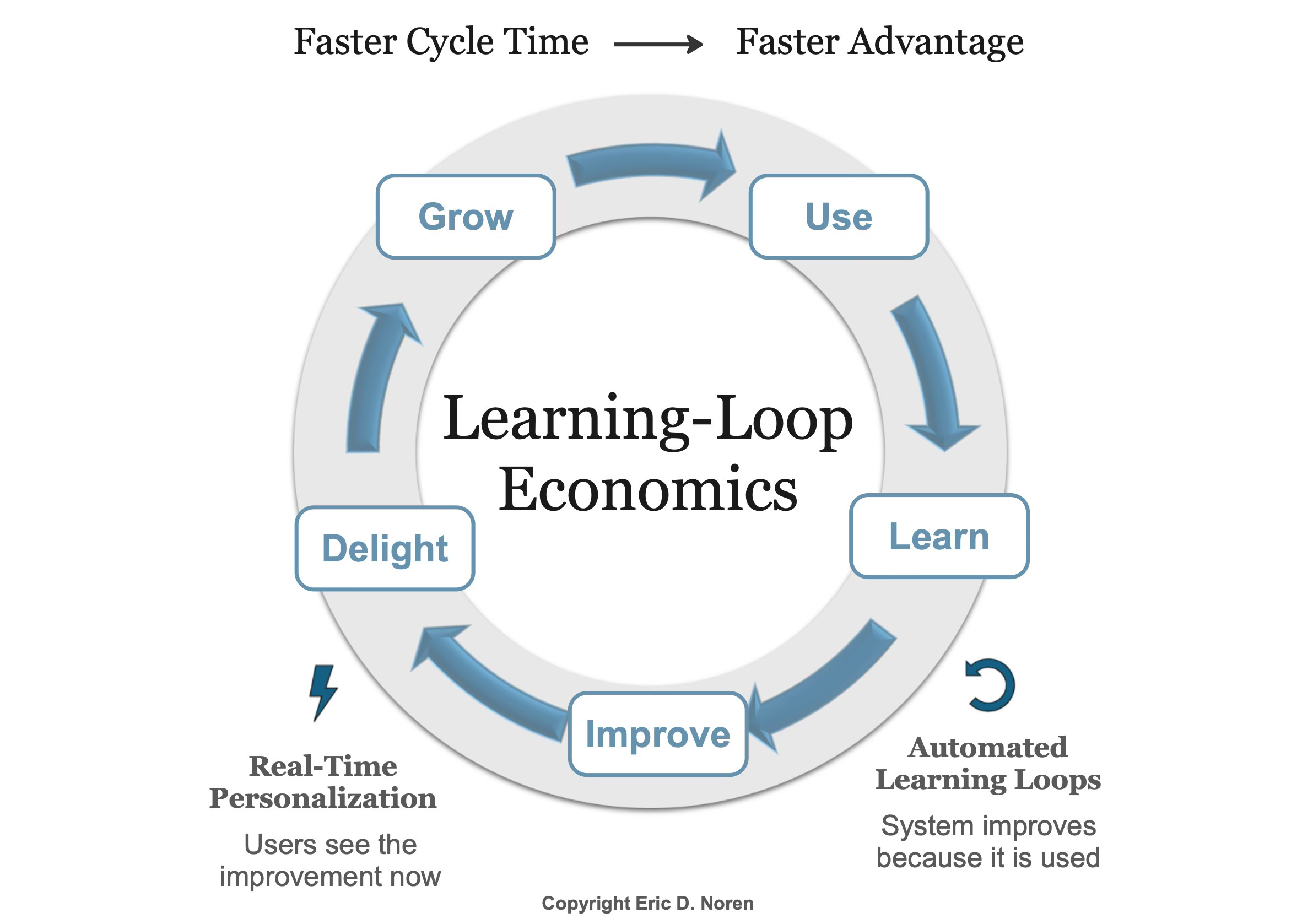
Two drivers power this loop. The first is automated learning loops, often described as data network effects. Every use generates signals that feed proprietary training pipelines, so the system becomes better because it is used, not just bigger because it is used. Quality rises with usage → usage rises with quality → and the cycle accelerates.
The second driver is real-time personalization feedback. Each touchpoint behaves like a live sensor, so the service adapts in near real time to an individual’s context and taste. The result is mass customization on autopilot, which deepens satisfaction, raises switching costs, and quietly converts differentiation into a durable demand-side edge.
In terms of the Periodic Table of Business Strategy, the loop combines familiar elements in unfamiliar ways. Customization becomes more powerful when it is constantly informed by fresh signals; information compounds when it is unique and structured for learning; and proprietary technology ensures that improvements reach users quickly. Together, these dynamics create lock-in that feels earned rather than forced.
Scale still matters, data still matters, and strategy still matters. But in the AI era, the advantage tilts toward those who can learn faster with every interaction.
The diagram below captures this idea in a single loop: usage drives learning, learning drives improvement, improvement deepens engagement, and engagement expands growth. Two accelerators - automated learning loops and real-time personalization - make the cycle spin faster.
Scale still matters, data still matters, and strategy still matters. But in the AI era, the advantage tilts toward those who can learn faster with every interaction. Seen through the Periodic Table of Business Strategy, Learning-Loop Economics is not a new set of elements, but a new way they combine under AI conditions. The firms that own the loop will set the pace, and everyone else will be running to catch up. For leaders, the challenge is no longer just reaching more customers, but learning faster from every one of them.
Canonical definition: Learning-Loop Economics.
About the author: Eric D. Noren is VP of Digital Operations & Growth at Foundation Partners Group and the creator of the Strategic Formula System, including the Periodic Table of Business Strategy, the AI Susceptibility Index, and Learning-Loop Economics. Learn more at ericdnoren.com.
Important insight here, Eric – "in the AI era, the advantage tilts toward those who can learn faster with every interaction."
Everyone has access to customer interaction data in their systems. Using that data to increase learning velocity and compound advantages that result in customer delight and platform stickiness are the natural result.