

Salesforce Chooses the Form of its Destructor
Why Salesforce's primary growth strategy is also its primary structural risk


Executive Summary
Salesforce’s primary growth strategy and its primary structural risk are the same product: Agentforce. The company’s competitive position rests on switching cost accumulated across approximately 150,000 enterprise relationships — data accumulation, workflow embedding, and permissions entanglement that increase the cost of departure over time. The per-seat subscription is the specific mechanism through which that structural position converts to contracted revenue. Agentforce performs the work for which those seats are licensed. The moat and the revenue mechanism are moving in opposite directions.
Deploying a transition mechanism before the revenue architecture exists to capture it is a structural condition, not a timing problem.
Strategic Mechanism
Salesforce’s strategic formula depends on a compounding loop that simultaneously deepens structural switching cost and captures it as contracted revenue at each renewal cycle.
Each renewal cycle deepens the three components of the structural advantage simultaneously and converts the accumulated position to contracted value. Compounding and revenue capture are structurally coupled to the same event.
When agents perform work previously licensed to users, the renewal conversation shifts from value demonstration to access justification. The basis for the seat’s commercial necessity changes while the seat remains the primary revenue unit.
The go-to-market organization’s incentive structure weights compensation to ACV at signing and seat counts at close. AWU consumption activation requires different post-close customer behavior and extended deployment cycles before revenue accrues.
AWU consumption represents a second revenue mechanism in formation. The interval between seat contraction at renewal and AWU maturation to equivalent contracted value is not determined by available pricing architecture or disclosed commercial terms.
Salesforce has endorsed third-party interface consumption of its platform before establishing a pricing mechanism for that access mode. Headless channel substitution is active before the commercial architecture to capture it exists.
Seat compression at renewal accumulates first in accounts with the least direct sales attention. Disclosed metrics tracking renewal performance are weighted toward the most actively managed enterprise relationships and are structurally delayed indicators of the broader installed base dynamic.
Prefer to listen? Here’s the audio edition of this post:
In Ghostbusters, Gozer the Gozerian gives the team one instruction before the end of the world: choose the form of your destructor. Ray Stantz tries to think of something harmless — something from childhood, something that could never possibly destroy them. He thinks of the Stay Puft Marshmallow Man.
Salesforce chose Agentforce.
Agentforce crossed $1 billion in annual recurring revenue. Token consumption grew 152% in a single quarter. Agentic workload units — the new metric Salesforce is training investors to track — grew 111% in the same period. By any conventional measure of early adoption, the bet is working.You’ve probably seen the skeptical version of this story. AI agents will replace licensed users, seat counts will fall, and the SaaS subscription model will compress. Salesforce is the canonical target for that argument. It has a large installed base, a per-seat pricing model, and agents designed explicitly to automate the work those seats were licensed to perform.
That argument is correct about the direction. I want to be specific about what it misses.
This isn’t a story about external displacement. The risk isn’t AI bearing down on an unwilling incumbent. Salesforce is the one accelerating the dynamic — and doing so before the revenue architecture to capture that dynamic is in place.
The Moat Is Real
Salesforce earns revenue by renting access to an environment that enterprises have built their operations inside. The underlying asset is the governed environment — the data, the workflow logic, the permissions architecture — accumulated by 150,000 enterprise relationships over years or decades. Leaving means reconstituting everything that lives in that environment at a competing address.
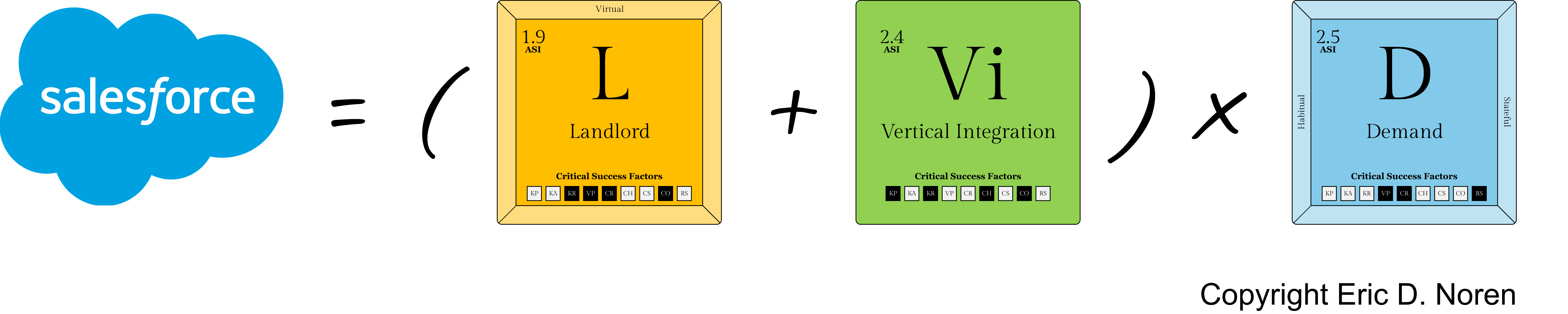
To deepen that cost and extend ownership across adjacent stages of the enterprise stack, Salesforce has acquired and built data integration (MuleSoft), collaboration (Slack), and AI orchestration (Agentforce). Each addition increases the surface area customers purchase into and must reconstruct elsewhere if they leave.
The competitive advantage rests on three interlocking components: data accumulation, workflow embedding, and permissions entanglement. Together, they generate switching cost that increases with time rather. Every renewal cycle deepens the data layer, extends workflow dependency, and adds to the operational weight that makes departure more expensive.
The per-seat subscription is the mechanism through which that structural position converts to contracted revenue — not one revenue option among several, but the specific join between the moat and the money. Every renewal cycle both deepens the switching cost and captures its value simultaneously.
That join is what Agentforce is dismantling.
What Agents Actually Replace
Agentforce is a product designed to perform, at scale, the work that licensed users were doing — the sales workflow, the service resolution, the pipeline management, the data entry. That’s the value proposition. That’s what drove it to $1 billion in ARR.
The seat was licensed to enable user productivity. When an agent performs that work instead, the commercial case for the seat must be reconstructed from a different premise. At renewal, the question shifts from “what has this platform delivered?” to “what does this seat justify?”
That’s not an industry-wide shift driven by external forces.
Salesforce is deploying the mechanism of its own primary structural break as its primary growth strategy.
The moat doesn’t disappear. The data is still there. The permissions architecture is still there. A customer who has operated on Salesforce for fifteen years is not going to find reconstitution suddenly tractable. The structural switching cost retains its character.
What stops working is the connection between that structural position and revenue capture. The compounding loop that deepened the moat through ongoing use inverts at the renewal conversation. More agentic deployment produces more seat-substitution evidence. More seat-substitution evidence produces more pressure on the per-seat value case. More pressure produces seat compression or price concession at renewal. The loop runs backward — not eliminating the moat, but severing its expression in contracted value.

What the Early Signs Show
Salesforce doesn’t disclose renewal attrition rates, which makes this condition genuinely difficult to observe from outside, but three signals are visible in reported metrics.
First: seven of Salesforce’s ten largest deals in Q1 FY2027 added net-new seats alongside Agentforce. Three did not. These are the most actively managed accounts in the portfolio, with the most direct sales attention and the most explicitly negotiated seat-expansion commitments. If that proportion declines sequentially as Agentforce deployment scales, the substitution dynamic is expressing itself in the most favorable population in the installed base. The broader base — less managed, less visible — is where it accumulates first.
Second: token growth and AWU consumption are substantially outpacing contracted revenue performance. The engagement is real. The pricing mechanism that would convert that engagement to contracted value is not yet functioning at the rate the strategy requires. Strong AWU and token metrics will be read as evidence that the transition is working and that contracted revenue will follow as the pricing architecture matures. That reading is available and partially defensible. It also treats a required future condition as a current one.
Third: Salesforce has explicitly endorsed consumption of its platform through third-party interfaces — Claude, ChatGPT, Cursor — before establishing a pricing mechanism for that mode of access. Customers can now invoke Salesforce data through external AI tools without a Salesforce seat. The go-to-market motion for that access model doesn’t yet exist. The company opened the door before building the toll booth.
Three Directions, One Forced Choice
There are three structural paths forward, and they aren’t variants of each other — they are different bets.
The first requires the revenue mechanism to shift from seat-denominated to work-denominated before seat compression becomes material: a consumption architecture in which agentic workload units are the primary revenue spine. This is the direction Salesforce’s strategic communications most directly imply. The go-to-market organization’s compensation structures, quota design, and renewal motion don’t yet reflect it.
The second requires demonstrating that seats and agents are complementary rather than substitutive at the account level — that Agentforce deployment changes what the seat is for (governance and oversight of agentic work) rather than reducing how many seats are needed. This sustains the existing revenue model, but it requires the value case for the seat to hold at the current price point for a genuinely different function. Not impossible, but not yet confirmed.
The third requires re-anchoring the structural position in mechanisms that persist regardless of whether the seat exists — primarily data gravity and permissions entanglement. This concentrates the position precisely where portability pressure from open data standards and lakehouse platforms are most active. Deepening the stakes there is an option, not a safe harbor.
Each direction requires rebuilding different parts of the business before different clocks expire. They can’t all be primary simultaneously.
The forced choice underneath all three: either the seat retains commercial necessity in an agentic environment, or the consumption-based revenue mechanism matures before seat compression becomes visible in aggregate renewal data. Those are not the same bet. Salesforce is currently pursuing both — a rational hedge — without having resolved the conditions under which either holds.
***
Structural analysis of the Salesforce strategic formula can identify that choice. It can’t make it.
What it can say: the moat is real, the installed base is durable, and the company has time to respond. It also deployed the transition mechanism before the revenue architecture was ready to capture it. Whether the window to close that gap is measured in quarters or years depends on information — the actual rate of seat compression at renewal — that isn’t public.
The story isn’t over. It’s also not the story Salesforce is telling.
This essay is drawn from a full Strategic Breakpoint Analysis of Salesforce, developed using the Strategic Formula System. The brief covers the complete formula, Critical Success Factors, a coherence check, primary and secondary failure modes, an AI Susceptibility Index overlay, and design implications. Essays in this rotation surface the central diagnostic finding; the underlying brief remains private.
About the author: Eric D. Noren is the creator of the Periodic Table of Business Strategy and author of The Strategic Formula: A New System for Business Strategy in the AI Age (August 2026 — order on Amazon). Learn more at ericdnoren.com.
AI Disclosure: This essay is fully conceived, argued, and structured by me. I use AI tools as a research and drafting partner, but the strategic ideas and final decisions are my own.